
In the Philippines, the Deed of Absolute Sale (DOAS) is an important document in the transfer of title to any property. But beyond this document, there are other fees and underestimated costs associated with the deed of sale for the transfer of title.
With updated BIR zonal values and stricter LRA (Land Registration Authority), many transactions get delayed, disputed, or unexpectedly expensive because of miscalculation of taxes, incorrect documents, and deadlines that may lead to penalties.
This guide breaks down all the actual costs and fees involved in a Deed of Sale in the Philippines, explains who pays what, and shows how a professional assistance can help you avoid unnecessary expenses and delays.
What is a Deed of Absolute Sale?
A Deed of Absolute Sale, also known as DOAS, is a legal document where the seller (the Vendor) transfers all their rights, interests, and title to a property buyer (the Vendee) in exchange for a specific sum of money.
In the Philippines, this document is essential because it is the primary legal basis for computing Capital Gains Tax (CGT), paying Documentary Stamp (DST), issuance of Electronic Certificate Authorizing Registration (eCAR), and transferring the title at the Registry of Deeds (RD).
Without the deed of sale, no government office will process your title transfer.
Components of a Deed of Sale
A valid Deed of Sale or DOAS has the following:
Complete Legal Names and Personal Details of the Parties
The DOAS must clearly state the full legal names of both the buyer and the seller, exactly as they appear on their government-issued IDs and land title. Any mismatch in spelling, initials, or civil status can result in BIR or Registry of Deeds rejection.
Detailed Description of the Property
The property description must be identical to what appears on the Transfer Certificate of Title (TCT) or Condominium Certificate of Title (CCT).
This includes:
- Title number (TCT or CCT)
- Lot number and block number (if applicable)
- Registered owner(s) as stated on the title
- Land area in square meters
- Location and boundaries
Errors in this section often require re-execution and re-notarization, leading to additional costs.
Total Purchase Price and Statement of Full Payment
The DOAS must explicitly state:
- The total consideration or purchase price
- That the amount has been fully paid and received by the seller
This declaration is critical because:
- It becomes the basis for Capital Gains Tax (CGT)
- It affects Documentary Stamp Tax (DST) computation
- It determines whether the sale is treated as absolute and final
Clear Date of Sale and Transfer or Ownership
The exact date of execution of the DOAS must be indicated.
This date:
- Starts the countdown for tax payment deadlines
- Determines the imposition of penalties and surcharges
- Establishes the official transfer of ownership
Incorrect or missing dates can result in late payment penalties, even if taxes are eventually paid.
Explicit Acknowledgment of Voluntary and Absolute Sale
The deed must contain a clear statement that:
- The seller voluntarily sells the property
- Ownership is transferred absolutely and without conditions
- The property is free from liens and encumbrances (or properly disclosed if not)
This protects both parties and supports smooth processing with government agencies.
Signatures of the Buyer, Seller, and Witnesses
The DOAS must be signed by:
- All registered owners/sellers
- The buyer(s)
- At least two witnesses
Signatures must:
- Match the IDs presented
- Be affixed in the presence of the notary public
Missing or inconsistent signatures are a common cause of document invalidation.
Proper Notarization by a Licensed Notary Public
Notarization is what converts the DOAS from a private document into a public instrument.
A valid notarization requires:
- Personal appearance of parties or authorized representatives with SPA
- Valid, current government-issued IDs
- A notary public with an active commission
Improper notarization can:
- Void the deed
- Prevent tax payment
- Force re-execution and additional fees
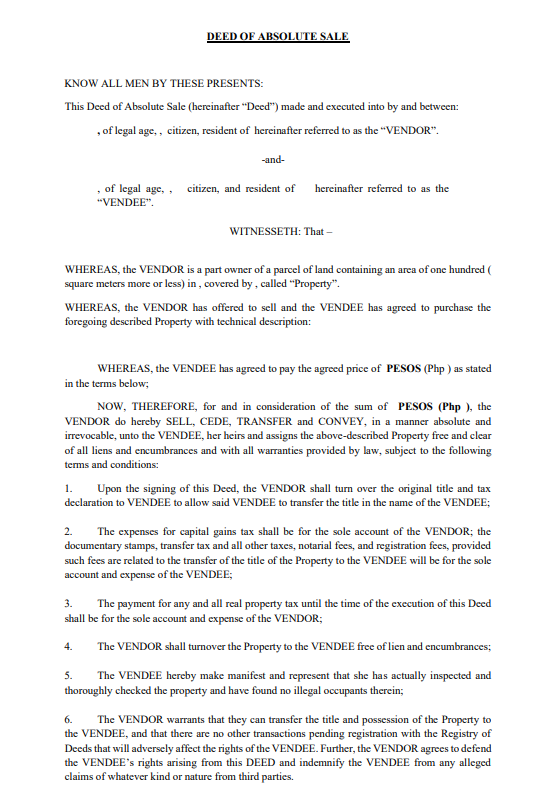
Sample of Deed of Sale
Why Deed of Sale Costs are Often Underestimated?
Most people assume the deed of sale is just a document that needs notarization. However, it is essential in other compliance throughout the process of title transfer. From paying mandatory taxes to the Bureau of Internal Revenue (BIR) to government fees from the Local Government Unit (LGU) and Registry of Deeds – Land Registration Authority (LRA).
Common cost-related mistakes include undelclared selling price of the property that may lead to BIR reassessment, incomplete or incorrect deed of absolute sale format, and missed tax deadline that incur surcharge resulting into a higher costs.
BIR Tax Computation for Deed of Sale of Real Property
Your property taxes will be computed based on whichever is highest among the gross selling price, bir zonal values, or fair market value. A Gross Selling Price (GSP) is the actual amount written on your Deed of Sale. The BIR Zonal Value is assigned by the BIR to the specific area. And the Assessor’s Fair Market Value (FMV) is the value stated on the latest Tax Declaration.
For example, you are buying a property amounting to 2,500,000 pesos based on the selling price value of the seller, but the fair market value says it’s worth 4,000,000 pesos, then you are paying taxes based on the FMV.
Costs and Fees in Transfer of Land Title
1. The Tax Base: The “Highest Value” Rule
Before calculating percentages, you must know that the government does not always use your purchase price. Taxes are computed based on the highest of:
- Selling Price: The amount on your Deed of Sale.
- Zonal Value: The value set by the Bureau of Internal Revenue (BIR).
- Fair Market Value: The value determined by the City/Provincial Assessor.
2. Mandatory Taxes (National Government)
- Capital Gains Tax (CGT) – 6%: This is a tax on the seller’s presumed profit. Even if the seller sold the land at a loss, the 6% tax based on the zonal value must still be paid to the BIR within 30 days of notarization.
- Documentary Stamp Tax (DST) – 1.5%: This is a tax on the documents and instruments. It must be paid by the 5th day of the month following the notarization.
3. Transfer Fees (Local Government)
- Local Transfer Tax – 0.5% to 0.75%: Paid to the City or Provincial Treasurer’s Office where the property is located.
- Registration Fees – Approx. 0.25%: Paid to the Register of Deeds to cover the administrative cost of printing and issuing your new title.
Why Professional Service Provider Important in Executing a Deed of Sale for Land Title Transfer?
Many buyers try to use a generic Deed of sale sample to save on legal fees. However, using a generic deed of sale often leads to BIR rejection that may lead to recomputation of taxes and delay of transfers. Partnering with a professional ensures that every document and process is in accordance with different government regulations. Here’s why:
- Penalty Avoidance: If you miss the 30-day BIR deadline for CGT, you will be charged with a 25% surcharge plus interest.
- Document Verification: Professionals verify that the “Absolute” sale is actually possible by conducting a property due diligence. Are there liens? Is there an encumbrance? Is the seller’s spouse actually in agreement?
- Correct Valuation: We cross-reference the latest 2026 zonal values to ensure you don’t underpay your taxes, which leads to your eCAR (Electronic Certificate Authorizing Registration) being denied.
Sounds Overwhelming? It doesn’t have to be!
A Deed of Absolute Sale is not a simple form, it is the legal and financial trigger for taxes, title transfer, and ownership recognition in the Philippines. Any error, omission, or inconsistency in this document directly results in delays, penalties, reassessments, and repeat costs.
Relying on generic deed of sale samples or DIY preparation may seem cost-effective at first, but in practice, it is the most common reason property transfers fail or become unnecessarily expensive.
If you value speed, accuracy, and full compliance, professional handling is not optional, it is the safer, smarter decision. At FileDocsPhil, we are committed in ensuring that the transfer of title is legally executed without any error and inconvenience.
Let FileDocsPhil Do the Work!
Let experienced professionals prepare and process your Deed of Absolute Sale and Transfer of Title correctly from day one.
Can I lower the Capital Gains Tax by declaring a lower price?
No. The BIR uses the highest value rule. Underdeclaration often results in reassessment and penalties.
Can the buyer pay the Capital Gains Tax?
Yes. While the law traditionally assigns this to the seller, the parties can agree that the buyer will shoulder all costs. This must be clearly stated in the Deed of Absolute Sale to avoid confusion during the BIR audit.
What happens if I don't notarize the Deed of Sale?
Without notarization, the document is a “private instrument.” It cannot be used to transfer the title at the Register of Deeds, and it does not bind third parties. It essentially leaves your ownership “invisible” to the government.
How long does the transfer process take?
Processing time varies, but errors in the deed of sale are the top cause of delays. Professional handling significantly shortens timelines.
How much does professional assistance cost?
Costs depend on the property and scope, but it is often far less expensive than fixing rejected or invalid documents.