

Planning to study, work, or migrate abroad? If your next step involves submitting your Transcript of Records (TOR), diploma, or academic certificates overseas, there’s one crucial requirement you cannot skip, apostille school records.
Many Filipinos only realize this at the last minute, often when a foreign university, employer, or licensing body suddenly asks for “apostilled documents.” The process can feel confusing at first, especially with multiple agencies involved, like DepEd, CHED, TESDA, and the DFA. The good news? Service providers like FileDocsPhil help you simplify the process.
In this updated guide, we’ll walk you through what an apostille means, how the DFA apostille process works, the exact requirements, how to secure your CAV, and how we can help you get your documents apostilled.
What is Apostille DFA?
A DFA apostille certificate is an official authentication issued by the Department of Foreign Affairs (DFA) that verifies the origin of a public document. It confirms that the signature, seal, or stamp on your school record is legitimate.
Since the Philippines is a member of the Hague Apostille Convention, documents authenticated with an apostille are automatically recognized by other member countries, no need for embassy or consular legalization.
Keep in mind that Apostille does NOT validate the content of your grades or degree. It only verifies the authenticity of the document and the authority who issued it.
Why Apostille School Records Are Required Abroad
Foreign institutions require apostilled academic documents to prevent fraud and ensure international document recognition. Apostilled school records are commonly needed for:
- Admission to universities and colleges abroad
- Employment overseas
- Professional licensing (nurses, engineers, teachers, etc.)
- Student visas and work permits
- Credential evaluation and equivalency
If you’re submitting documents to a country outside the Apostille Convention (e.g., UAE, Qatar), you’ll need an additional authentication, which is the Embassy legalization.
Requirements for Apostille of School Records in the Philippines
Before heading to the DFA apostille, your documents must go through a Certification, Authentication, and Verification (CAV) process. This is where most applicants get confused.
Below is a breakdown based on educational level:
Elementary & High School Records (Form 137, Diploma)
- Certified True Copies from the school
- CAV issued by the DepEd Regional Office
Technical & Vocational Courses (TOR, Diploma, National Certificate)
- Certified True Copies from the school
- CAV from TESDA
State Universities and Colleges
- Certified True Copies of TOR and Diploma
- CAV issued directly by the state university or college
Private Colleges and Universities
- Certified True Copies from the school
- CAV from CHED
These are part of the official DFA apostille requirements for educational documents in the Philippines.
Additional DFA Apostille Requirements
- Original or certified true copy of the document
- Valid government-issued ID
- Confirmed DFA apostille appointment
Incomplete documents are the most common cause of delays.
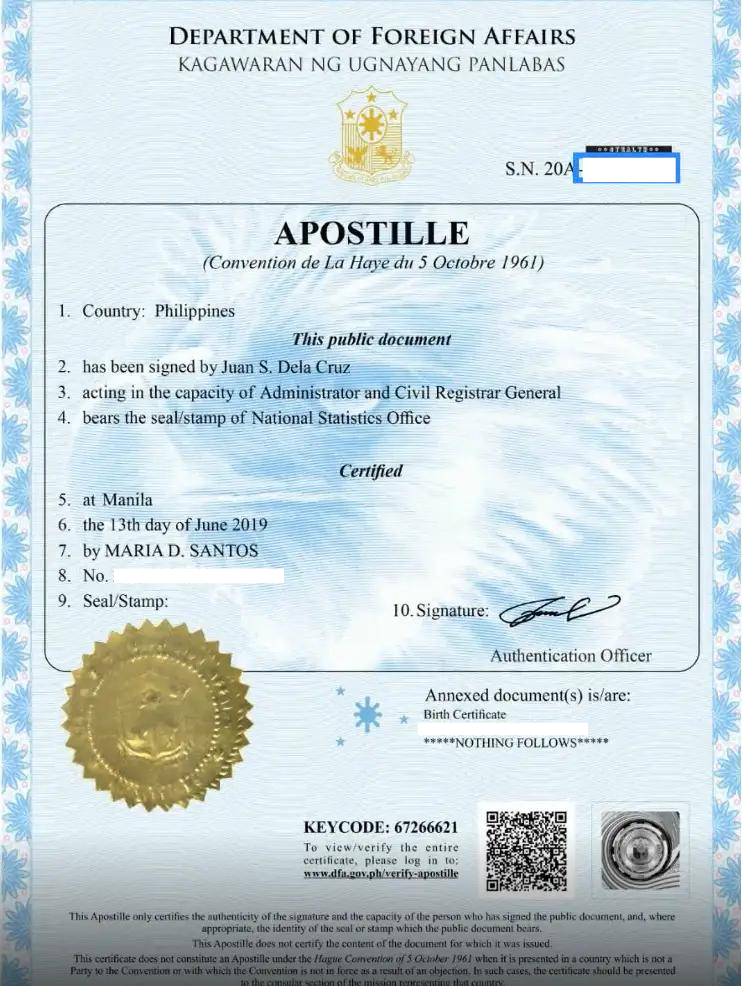
Sample of DFA Apostille Certificate
How to Secure a Certification, Authentication, and Verification (CAV)
The CAV certifies that your academic records are authentic and officially issued. This is a mandatory step before DFA apostille for school documents.
General CAV Process
- Request Certified True Copies from your school and inform them they’ll be used for CAV
- Your school will either:
- Submit the documents directly to DepEd, CHED, or TESDA; or
- Release the documents to you for manual submission
- Submit the documents directly to DepEd, CHED, or TESDA; or
- Once issued, the CAV may also need to be apostilled if required abroad
- Submit both the CAV and school records to the DFA for apostille
Processing timelines vary, so always confirm with your school or issuing agency.
How Do I Apostille My School Documents in the Philippines?
To apostille your school documents in the Philippines, you must first secure certified true copies and a CAV from the appropriate authority (DepEd, CHED, TESDA, or your state university). Once completed, you book a DFA apostille appointment, submit the documents, and wait for the apostille certificate to be released. This process is governed by the Apostille Convention and handled exclusively by the DFA.
Take note that the timeline depends on the availability of your appointment to process your documents at the DFA. The government agency has a limited slot to accommodate the process per day.
Basic Facts When Getting Your School Records Apostilled
To help you further, the basic facts when getting your school records apostilled:
- You must make sure you have prepared at least three (3) photocopied sets of your original Transcript of Record (TOR) and Diploma from the College or University you attended.
- Your TOR and Diploma need to be notarized/certified by the school registrar as well. In this way, your document would be eligible for the Apostille.
- For countries not included in the Hague Convention, like Dubai or Canada, for example, an attestation of documents is further required. Countries that are not part of this treaty will not accept apostilled documents (i.e., TOR and Diploma) unless you provide them further with a certificate of authentication from their Consular Office/Foreign Embassy. Take note that for the attestation of your documents, it is best to set a budget for it as it is a different process altogether.
- Apostille seals executed for authentication only apply to legal documents that are intended to be submitted abroad. If your document is for local submission, apostille certificates will not be issued as there is no need for it.
- Since the Department of Foreign Affairs (DFA) red ribbons are no longer issued and is replaced by apostille certificates using a seal, it is important to understand that once your document is authenticated by the DFA, you no longer need to visit the consular or embassy of the apostille-contracting country you are in.
- It is understood that apostille certificates only verifies the origin of the legal document to be submitted – such as the person or authorized representative whose signature appears in that said document. It does not attest to the content of the document – so bear this in mind when apostilling your school records.
Sounds Overwhelming? It doesn’t have to be!
Apostille of school records in the Philippines may seem complex at first, but once you understand the requirements—especially the need for a CAV and proper DFA apostille procedures—the process becomes much more manageable. Whether you’re applying for studies, work, or professional licensing abroad, securing an apostille certification for transcripts and other academic documents is a critical step to ensure international acceptance. To save time, avoid costly mistakes, and meet tight deadlines, partnering with a top-rated apostille service for academic records and professional apostille agents for school paperwork can make all the difference in completing the process smoothly and stress-free.
Let FileDocsPhil Do the Work!
At Filedocsphil, we specialize in handling apostille school records, CAV processing, and DFA submissions from start to finish. Whether you’re applying for school, work, or migration, we simplify the entire journey.
How to apostille educational documents?
Secure certified true copies, obtain a CAV, then submit all documents to the DFA Apostille Philippines via appointment.
How long is an Apostille good for?
An apostille does not expire because it only certifies the authenticity of a document at the time it was issued. However, the acceptance depends on the validity of the underlying document and the requirements of the receiving country or institution.
Which documents are required to be apostilled?
Documents used abroad such as diplomas, TORs, birth certificates, NBI clearance, and civil registry documents.
Can I walk in at DFA for apostille?
No. The DFA strictly requires a DFA apostille appointment booked online.
How many days does the DFA apostille take?
Processing usually takes 3–7 working days, depending on the DFA branch and document volume.



One Response
Wow, awesome blog layout! How long have you been blogging for?
you make blogging look easy. The overall look of your web site is excellent, as well as the content!