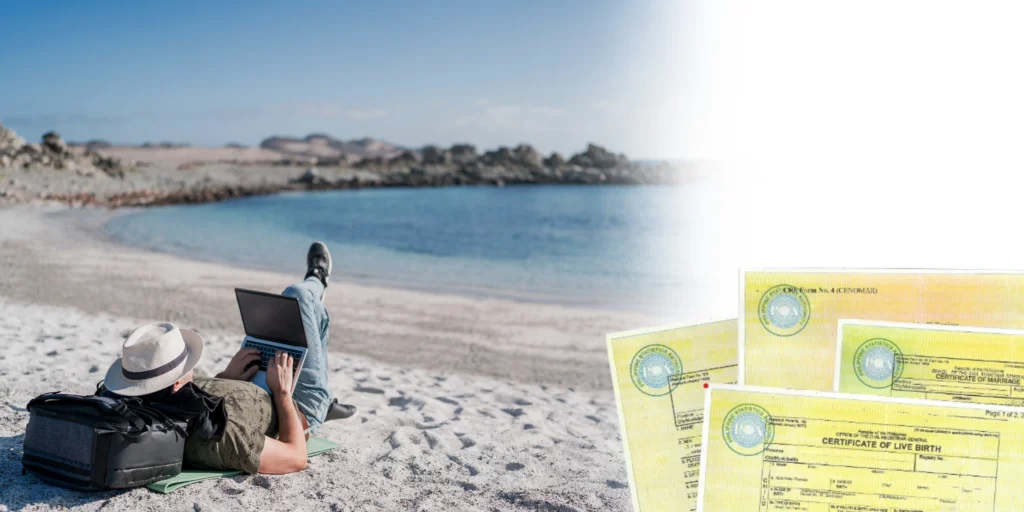
The freedom to work from anywhere has made the digital nomad lifestyle more popular than ever. Whether you’re working remotely from Spain, Japan, Thailand, or another country offering a digital nomad visa, international opportunities often come with important legal requirements, especially if you’re applying for dual citizenship.
One of the most essential documents you’ll need is a PSA Birth Certificate. More than just a record of your birth, it serves as official proof of your identity, parentage, and eligibility for citizenship, making it a key requirement in many dual citizenship applications. Without an accurate and updated PSA Birth Certificate, your application may face unnecessary delays or complications.
In this guide, you’ll learn why a PSA Birth Certificate is crucial for digital nomads pursuing dual citizenship, the application process, common challenges, and how professional assistance can help make the process faster and hassle-free.
What is a Digital Nomad?
A digital nomad is an individual who earns income remotely while living or traveling in different countries. Instead of working from a permanent office, digital nomads rely on internet connectivity to perform their jobs from cafés, coworking spaces, apartments, or virtually anywhere in the world.
Common digital nomad jobs include:
- Software development
- Digital marketing
- Graphic design
- Content writing
- SEO consulting
- Online teaching
- Customer support
- Virtual assistance
- Video editing
- Business consulting
As more countries recognize the growing remote workforce, governments have introduced specialized digital nomad visa programs.
Popular destinations include:
- Spain
- Japan
- South Korea
- Thailand
- Portugal
- Estonia
- Croatia
While these visas allow remote workers to stay legally abroad, they do not replace citizenship documentation. This becomes especially important when applying for dual citizenship or proving eligibility based on Filipino ancestry.
What is a PSA Birth Certificate and Why Does it Matter to a Digital Nomad?
To understand why this document is non-negotiable, we first need to define what is digital nomad documentation standard. A PSA birth certificate is an official vital document issued by the Philippine Statistics Authority. Printed on secure, counterfeit-proof security paper (SECPA), it serves as the ultimate legal proof of an individual’s birth, identity, and filiation (parentage) in the Philippines.
For remote workers hopping across borders, a standard scanned copy or a local civil registry printout will not cut it. Foreign governments and consulates demand the highest level of document verification.
When you apply for a digital nomad visa, a residency permit, or full dual citizenship, immigration authorities must verify your identity beyond a shadow of a doubt. The PSA birth certificate acts as the primary link connecting your current legal identity to the lineage that qualifies you for a second passport.
Common Reasons Digital Nomads Need a PSA Birth Certificate
Many remote professionals assume passports alone are sufficient.
In reality, a PSA Birth Certificate is often required for various legal and immigration purposes. Common situations include:
- Proving Ancestral Lineage (Jus Sanguinis): If you are applying for citizenship by descent (such as Spanish, Italian, or Filipino dual nationality), you must present an unbroken chain of PSA vital documents, including birth and marriage certificates, to prove your legal connection to your ancestors.
- Applying for Long-Term Visas: Before transitioning to full citizenship, you might utilize temporary pathways. Consulates reviewing applications for a digital nomad visa Spain or a digital nomad visa Korea frequently require apostilled birth certificates to run background checks and verify your civil status.
- Passport Renewal and Dual Identity Alignment: If you already qualify for dual citizenship under the standard Republic Act 9225 (for natural-born Filipinos who became citizens of another country), the Philippine embassy will require a PSA birth certificate to issue your new Philippine passport.
- Legal Name Corrections: Discrepancies between your foreign passport and your birth records will halt your citizenship application instantly. A PSA document is required to initiate any official corrections.
Step-by-Step Process of Obtaining a PSA Birth Certificate for Dual Citizenship
Step 1: Confirm Your Birth Record
Verify that your birth has been registered with the Philippine Statistics Authority.
If your birth record originated from the Local Civil Registry, ensure it has already been endorsed to the PSA.
Step 2: Prepare Valid Identification
Applicants typically need:
- Valid government-issued ID
- Authorization letter (if applying through a representative)
- Supporting identification documents
Step 3: Request the PSA Birth Certificate
You may obtain your PSA Birth Certificate through:
- PSA-authorized channels
- Online application services
- Walk-in requests (where applicable)
- Authorized representatives
Step 4: Secure Authentication or Apostille
Some foreign governments require additional document authentication before accepting Philippine civil documents.
Depending on the destination country, your PSA Birth Certificate may need:
- Apostille
- Consular authentication
- Embassy legalization
Always verify the documentary requirements of the country where you’re applying for dual citizenship.
Step 5: Secure an Official Certified Translation
If you are applying for citizenship in a non-English speaking country (such as Spain or Italy), your apostilled PSA birth certificate must be translated by a certified, sworn translator (traductor jurado).
Step 6: Submit with Your Citizenship Application
Include the PSA Birth Certificate together with other required documents, such as:
- Passport
- Marriage certificate (if applicable)
- Parent’s citizenship documents
- Naturalization certificates
- Government application forms
How a Professional Service Provider Can Help
Applying for dual citizenship while living abroad can be challenging, especially when obtaining and authenticating Philippine documents. A professional service provider, such as FileDocsPhil, can simplify the process by assisting with the retrieval of your PSA Birth Certificate, verifying document accuracy, coordinating Apostille or authentication services when required, and ensuring compliance with government requirements.
With expert guidance, you can minimize delays, avoid costly mistakes, and complete your application more efficiently, allowing you to focus on your digital nomad lifestyle while your documentation is handled with care.
Sounds Overwhelming? It doesn’t have to be!
Living as a digital nomad offers unparalleled freedom to work from almost anywhere in the world. However, international mobility also comes with important legal responsibilities, especially when applying for dual citizenship.
A PSA Birth Certificate remains one of the most essential documents for verifying identity, proving family lineage, and satisfying citizenship requirements. Preparing your documents early, ensuring their accuracy, and understanding authentication requirements can save significant time and prevent unnecessary delays.
If you’re planning to apply for dual citizenship while living abroad, don’t leave your documentation to chance. Ask a professional PSA assistance with FileDocsPhil.
Let FileDocsPhil Do the Work!
Need assistance obtaining your PSA Birth Certificate, Apostille, authentication, or other Philippine civil documents? Message us today!
Why is a PSA Birth Certificate required for dual citizenship?
A PSA Birth Certificate serves as official proof of your identity, birth details, and parentage, helping government authorities verify your eligibility for dual citizenship.
Can I apply for a PSA Birth Certificate while living abroad?
Yes. Overseas Filipinos and digital nomads can request PSA Birth Certificates through authorized representatives or accredited online channels, depending on the available services.
Does my PSA Birth Certificate need an Apostille?
It depends on the country where you’ll submit your dual citizenship application. Some countries require Apostille or additional authentication before accepting Philippine-issued documents.
What happens if my PSA Birth Certificate contains errors?
You should have the errors corrected through the appropriate civil registry procedures before using the document for citizenship applications, as discrepancies may cause delays or rejection.
What happens if my PSA Birth Certificate contains errors?
Yes. Professional service providers can assist with obtaining PSA Birth Certificates, document verification, Apostille processing, authentication, and coordinating the necessary paperwork, making the process more efficient for applicants living overseas.